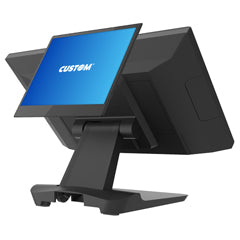

Integrated credit card processing and standalone credit card terminals can both accept card payments, but they create very different checkout workflows. For retail stores, liquor stores, convenience stores, grocery stores, restaurants, and service businesses, the difference affects transaction speed, cashier accuracy, reporting, reconciliation, customer experience, and the way your POS hardware works together.
If you are using a separate credit card machine beside your register, your staff may be entering the sale total twice: once into the POS system and again into the payment terminal. An integrated setup connects the POS sale and the payment transaction so the checkout process is cleaner, faster, and easier to manage.
Biztracker Infinity is a strong example of a POS system built for a more connected retail workflow. Biztracker positions Infinity as a retail POS and business management system that can bring sales, payments, inventory, reporting, and checkout operations closer together instead of forcing merchants to rely only on a disconnected standalone credit card terminal.
Quick Answer: Integrated Processing vs Standalone Credit Card Terminals
Integrated credit card processing connects the payment device to the POS system so the sale amount can flow from the POS to the payment terminal. The customer pays, the payment response returns to the POS, and the transaction is completed in a connected checkout workflow.
Standalone credit card terminals work separately from the POS system. The cashier rings up the sale in the POS, manually enters the total into the terminal, waits for payment approval, and then returns to the POS to complete or mark the sale as paid.
For most businesses that care about speed, accuracy, reporting, and reconciliation, integrated processing is usually the better long-term checkout setup. Standalone terminals can still make sense for simple payment acceptance, backup processing, temporary checkout stations, or businesses that do not need payment data tied into their POS reports.
What Is Integrated Credit Card Processing?
Integrated credit card processing means your POS system and payment terminal communicate during the sale. Instead of manually typing the transaction amount into a separate credit card machine, the POS sends the total to the terminal. After the customer pays, the terminal sends the payment result back to the POS.
This creates a more controlled checkout process. The cashier does not have to re-enter the sale amount, the POS can record the payment status more accurately, and the business can review sales and payments with less manual reconciliation.
Integrated processing is especially useful when the checkout station includes multiple connected components, such as POS hardware, receipt printers, cash drawers, barcode scanners, customer displays, label printers, and back-office reporting tools.
What Is a Standalone Credit Card Terminal?
A standalone credit card terminal is a payment device that operates separately from the POS system. The terminal may connect to a payment processor, but it does not automatically receive the sale total from the POS or send the payment result back into the POS transaction.
In a standalone setup, the cashier usually completes two separate workflows:
- Ring up the sale in the POS system.
- Manually enter the payment amount into the credit card terminal.
- Wait for approval from the terminal.
- Return to the POS and mark the sale as paid.
- Print or provide receipts from the POS, the terminal, or both.
This can work for very simple environments, but it adds extra steps at checkout and increases the chance of cashier mistakes.
Integrated Processing vs Standalone Terminal Comparison
| Category | Integrated Credit Card Processing | Standalone Credit Card Terminal |
|---|---|---|
| POS Connection | Payment terminal communicates with the POS system. | Payment terminal operates separately from the POS. |
| Amount Entry | Sale total can be sent from the POS to the terminal. | Cashier usually enters the total manually. |
| Checkout Speed | Usually faster because there are fewer manual steps. | Can be slower because the payment and POS workflows are separate. |
| Error Risk | Lower risk of mismatched payment and sale totals. | Higher risk of keying errors and reconciliation problems. |
| Reporting | Sales and payment activity can be easier to review together. | POS reports and processor reports may need to be compared separately. |
| Cashier Training | One connected checkout process is easier to standardize. | Employees must learn separate POS and terminal steps. |
| Refunds and Voids | Can be cleaner when supported by the POS and payment integration. | May require separate handling in the terminal or processor portal. |
| Best Fit | Retail, liquor, grocery, convenience, restaurant, counter-service, and multi-lane checkout environments. | Simple payment setups, backup terminals, events, mobile use, or low-volume checkout. |
Where Biztracker Infinity Fits
Biztracker Infinity is designed for businesses that need more than a basic payment terminal. Instead of treating payments as a separate step after the sale, Biztracker Infinity supports a broader POS workflow where checkout, inventory, reporting, and payment activity can be managed in a more connected way.
For a business currently using a standalone credit card terminal, moving to a system such as Biztracker Infinity can help reduce double entry, improve checkout consistency, and make payment activity easier to manage alongside POS sales. This is especially important for merchants that want better control over inventory, employees, customer transactions, receipts, departments, and day-end reporting.
Biztracker Infinity is also relevant for merchants reviewing credit card processing costs and payment integration options. If you are using a standalone terminal or feel your merchant account fees are too high, a connected POS and processing review may help identify a better long-term setup.
Spartan POS can help businesses review the checkout hardware side of a Biztracker Infinity environment, including compatible POS hardware, receipt printers, cash drawers, barcode scanners, 2D barcode scanners, and other accessories that support a complete checkout station.
Why Businesses Move Away from Standalone Credit Card Terminals
A standalone terminal may seem simple at first, but it can create operational friction as the business gets busier. Every transaction requires extra attention from the cashier. If the cashier enters the wrong amount, forgets to complete the payment, or marks a sale incorrectly in the POS, the business may not catch the problem until reconciliation.
Common problems with standalone credit card terminals include:
- Double entry: The sale amount must be entered in both the POS and the terminal.
- Keying mistakes: A cashier can accidentally enter the wrong payment amount.
- Slower checkout: Staff must move between two separate workflows.
- Separate receipts: The POS and terminal may generate different receipts.
- Harder reconciliation: POS reports and card processing reports may not match cleanly.
- More training: New employees need to learn both the POS process and terminal process.
- Less visibility: Managers may need to review multiple systems to understand what happened during a shift.
Why Integrated Processing Is Better for Checkout Accuracy
Checkout accuracy matters in every business, especially when employees are handling fast-moving lines, multiple payment types, discounts, taxes, returns, and customer questions. Integrated processing helps remove one of the most common sources of payment mistakes: manually entering the transaction total into a separate terminal.
When the POS sends the payment amount to the terminal, the cashier does not need to type it twice. That can reduce mismatched transactions, undercharges, overcharges, and end-of-day confusion.
This is particularly valuable for businesses using barcode-based checkout. A cashier can scan items with a barcode scanner, the POS calculates the total, and the integrated payment terminal receives the amount from the POS workflow. For stores using mobile coupons, QR codes, product labels, or ID scanning, a 2D barcode scanner may also be part of the same checkout station.
Integrated Processing and Reporting
One of the biggest advantages of integrated credit card processing is cleaner reporting. When payments are disconnected from the POS, managers may have to compare POS sales reports against payment terminal batches, processor settlement reports, and refund records. This can take extra time and may still leave questions if employees made mistakes during checkout.
With an integrated POS workflow, sales and payment activity can be easier to review together. This can help businesses understand card sales, cash sales, refunds, voids, employee activity, daily totals, departments, and location performance more clearly.
| Reporting Need | Integrated Processing Advantage | Standalone Terminal Challenge |
|---|---|---|
| End-of-Day Reconciliation | POS and payment activity can be easier to compare. | Reports may need to be matched manually. |
| Employee Accountability | Transactions can be easier to associate with POS users. | Payment activity may be harder to connect to specific POS actions. |
| Refund Review | Refunds may be easier to track when supported by the POS integration. | Refunds may need to be reviewed in a separate payment system. |
| Multi-Register Reporting | Cleaner structure for stores with multiple checkout lanes. | Separate terminal batches can make review more complicated. |
| Owner and Manager Visibility | Better view of sales and payment activity from the POS workflow. | Managers may need to check multiple systems. |
Integrated Processing and Inventory Management
Integrated payment processing becomes more valuable when the POS system also manages inventory. In a connected checkout workflow, the POS does more than collect payment. It can scan items, apply pricing, calculate tax, reduce inventory, record the sale, open the cash drawer when appropriate, print a receipt, and track the payment method.
For businesses using Biztracker Infinity, this broader retail management workflow is part of the reason integrated processing can be more valuable than a standalone terminal. The payment step should support the sale instead of sitting outside the POS process.
Businesses that rely on inventory accuracy should also review hardware such as barcode scanners, wireless barcode scanners, mobile computers, label printers, barcode labels, and thermal transfer ribbons.
Integrated Processing by Business Type
| Business Type | Why Integrated Processing Helps | Related Hardware to Review |
|---|---|---|
| Retail Stores | Helps connect item scanning, payment, receipts, inventory, returns, and reporting. | Barcode scanners, receipt printers, cash drawers |
| Liquor Stores | Supports fast checkout, product scanning, tax handling, receipt printing, and payment control. | 2D scanners, POS hardware, receipt paper |
| Convenience Stores | Helps reduce cashier errors during high-volume, fast-moving checkout. | Barcode scanners, receipt printers, cash drawers |
| Grocery Stores | Improves transaction speed when scanning many items and collecting card payments. | 2D scanners, receipt printers, barcode labels |
| Restaurants and Counter Service | Can support faster payment, receipt printing, cash drawer control, and tip workflows depending on setup. | Receipt printers, cash drawers, POS hardware |
| Warehouse Counter Sales | Connects scanning, inventory, customer pickup, payments, and receipts in a more controlled workflow. | Rugged scanners, long-range scanners, mobile computers |
When a Standalone Credit Card Terminal Still Makes Sense
Standalone terminals are not always the wrong choice. Some businesses use a standalone terminal because it is simple, familiar, portable, or already provided by their processor. A standalone terminal can also be helpful as a backup if integrated processing is unavailable.
A standalone credit card terminal may make sense when:
- You need a backup payment device.
- You are running a temporary checkout station.
- You take payments away from the main counter.
- Your transaction volume is low.
- You do not need payment data tied into your POS reporting.
- Your POS system does not support the desired processor or terminal.
- You need a simple short-term payment setup while planning a larger POS upgrade.
Even if you keep a standalone terminal, it is still worth reviewing the rest of your checkout setup. The right receipt printer, receipt paper, cash drawer, and barcode scanner can make the POS station more reliable.
Payment Integration Partners and Processor Compatibility
Payment integration depends on the POS system, processor, gateway, terminal model, firmware, network setup, and merchant account configuration. Biztracker references payment-related partners and technologies such as Datacap, Fiserv, Mercury, Givex, Worldpay, Sterling Payment Systems, and other processing options in its broader payment and POS ecosystem.
The important takeaway is that integrated processing is not just about buying any credit card terminal. The terminal must be supported by the POS software and payment processing environment. Before ordering payment hardware, confirm which devices, processors, connection types, and settings are supported for your exact Biztracker Infinity setup.
Spartan POS can help review the POS hardware side of the project, but payment processing approval, merchant account setup, processor compatibility, and gateway configuration should be confirmed before finalizing the terminal order.
Hardware to Review Before Choosing Integrated Processing
A payment terminal is only one part of the checkout station. Before choosing integrated processing or a standalone terminal, review the complete workflow around the sale.
| Hardware or Workflow | Why It Matters | Shop or Learn More |
|---|---|---|
| POS Hardware | The POS station must support the software, peripherals, and checkout workflow. | Shop POS hardware |
| Receipt Printers | Receipts may print from the POS, payment terminal, or both depending on configuration. | Shop receipt printers |
| Receipt Paper | Paper size must match the receipt printer model and roll specifications. | Shop receipt paper |
| Cash Drawers | Cash drawer control depends on the POS, printer, cable, and supported connection method. | Shop cash drawers |
| Barcode Scanners | Scanners help speed checkout and reduce product lookup errors. | Shop barcode scanners |
| 2D Barcode Scanners | Useful for QR codes, mobile coupons, IDs, and modern barcode workflows. | Shop 2D barcode scanners |
| Label Printers | Helpful for inventory labels, price labels, product labels, and warehouse workflows. | Shop label printers |
| Barcode Labels | Label quality affects scan reliability at checkout and during inventory work. | Shop barcode labels |
Receipt Printing: Integrated vs Standalone Payment Setups
Receipt printing can be more confusing when the payment terminal is standalone. The terminal may print a payment receipt, while the POS prints a separate itemized sales receipt. This can create extra paper, extra steps, and customer confusion if the two receipts do not clearly match.
With integrated processing, the POS workflow may be able to produce a cleaner receipt process depending on the software, processor, printer, and configuration. This can be helpful for businesses that need item details, tax details, return policies, payment method information, receipt copies, or customer-facing receipt options.
Review receipt printers and receipt paper when planning a payment integration project. Receipt printer interface options, paper size, drawer kick connections, and POS software compatibility can all affect the final setup.
Cash Drawer Control and Payment Workflow
Cash drawer control is another reason the full checkout setup matters. In many POS environments, the cash drawer opens through the receipt printer, not directly through the payment terminal. In other setups, the cash drawer may depend on the POS terminal, printer cable, interface, and software settings.
Integrated processing does not automatically solve every cash drawer requirement, but it can help keep the payment workflow more organized. Card sales, cash sales, refunds, and drawer activity should be reviewed as part of the complete checkout design.
Before ordering, confirm how your cash drawer, receipt printer, payment terminal, and POS software are expected to work together.
Questions to Ask Before Moving from a Standalone Terminal to Integrated Processing
- Does your POS software support integrated payment processing?
- Which payment processors are supported?
- Which credit card terminals are approved for your setup?
- Does the terminal connect by Ethernet, USB, Wi-Fi, Bluetooth, or another method?
- Does the payment device need to face the customer?
- Do you need EMV chip, contactless, PIN debit, signature capture, or tip prompts?
- Will receipts print from the POS, the terminal, or both?
- Will the cash drawer open through the receipt printer or another device?
- Will barcode scanners, label printers, scales, or customer displays be part of the same checkout setup?
- Do you need sales and payment reporting tied to employees, departments, inventory, or locations?
- Who will support the POS hardware if something does not work correctly?
Common Buying Mistakes to Avoid
Payment terminal projects often go wrong when the terminal is selected before the full POS workflow is confirmed. Avoid these common mistakes:
- Buying a terminal before confirming POS compatibility: Not every terminal works with every POS system or processor.
- Ignoring processor requirements: The merchant account, gateway, and processor must support the intended integration.
- Assuming any receipt printer will work: Receipt printer compatibility depends on software, drivers, interface, and paper size.
- Forgetting about the cash drawer: Drawer control may require a specific printer, cable, or configuration.
- Choosing the wrong scanner type: Some businesses need 2D scanning, wireless scanning, rugged scanning, or mobile computers instead of a basic scanner.
- Skipping support planning: Integrated checkout involves software, payment processing, network setup, and hardware. Know who supports each part.
Compatibility Guidance
Payment processing compatibility depends on the POS software, processor, merchant account, gateway, terminal model, firmware, connection method, operating system, drivers, and configuration. A credit card terminal that works in one business may not work the same way in another setup.
Compatibility depends on your POS software, operating system, connection type, drivers, accessories, and configuration. Confirm compatibility before ordering.
If you are planning a Biztracker Infinity checkout setup, confirm the exact payment terminal, processor, integration method, receipt printer, cash drawer, scanner, and accessory requirements before ordering hardware. Review the POS Hardware Compatibility Guide or contact Spartan POS for help reviewing the hardware side of your setup.
Integrated Processing vs Standalone Terminal: Which Should You Choose?
Choose integrated credit card processing if you want a faster and more connected checkout workflow. It is usually the better choice for businesses that rely on POS reporting, inventory, barcode scanning, receipts, cash drawer control, and employee accountability.
Choose a standalone credit card terminal if you need a simple payment device, a backup terminal, a temporary setup, or a payment workflow that does not need to connect directly to your POS system.
| Choose This | When It Makes Sense |
|---|---|
| Integrated Processing | You want POS-connected payments, fewer cashier errors, cleaner reporting, faster checkout, and a better long-term retail workflow. |
| Standalone Terminal | You need simple payment acceptance, backup processing, mobile use, temporary checkout, or a setup that does not require POS integration. |
Related POS Hardware and Resources
Use these related categories and guides to build a stronger checkout setup around your POS and payment workflow:
- POS Hardware
- Receipt Printers
- Receipt Paper
- Cash Drawers
- Barcode Scanners
- 2D Barcode Scanners
- Wireless Barcode Scanners
- Rugged Barcode Scanners
- Long-Range Barcode Scanners
- Mobile Computers
- Label Printers
- Barcode Labels
- Thermal Labels
- Thermal Transfer Ribbons
- POS Hardware Compatibility Guide
- POS Hardware Setup and Troubleshooting
- Authorized POS Hardware Dealer Support
- Why Trust Spartan POS
- Contact a POS Hardware Expert
Why Buy POS Hardware from Spartan POS?
Spartan POS helps businesses choose POS hardware for real checkout environments, not just individual devices. That matters when payment processing, POS software, receipt printing, cash drawer control, barcode scanning, and inventory workflows all need to work together.
Spartan POS is an authorized dealer for many of the POS hardware brands it sells and supports the products it sells. If you are reviewing Biztracker Infinity, integrated credit card processing, or a move away from a standalone terminal, Spartan POS can help you review the hardware pieces that support the checkout workflow.
For help with terminals, printers, drawers, scanners, and complete POS hardware planning, visit Contact a POS Hardware Expert.
Frequently Asked Questions
What is the difference between integrated processing and a standalone credit card terminal?
Integrated processing connects the payment terminal to the POS system so the sale amount and payment result can move through a connected checkout workflow. A standalone credit card terminal works separately, so the cashier usually enters the amount into the terminal manually and then completes the sale in the POS separately.
Is integrated credit card processing better than a standalone terminal?
Integrated processing is usually better for businesses that want faster checkout, fewer cashier mistakes, cleaner reporting, and a more professional POS workflow. A standalone terminal may still be useful for backup processing, temporary checkout, mobile payments, or simple low-volume environments.
How does Biztracker Infinity relate to integrated processing?
Biztracker Infinity is a retail POS and business management system that can support a more connected checkout workflow than a basic standalone terminal setup. For merchants using or evaluating Biztracker Infinity, the payment terminal, processor, POS hardware, receipt printer, cash drawer, and scanner should be reviewed together before ordering.
Can integrated processing reduce cashier errors?
Yes. Integrated processing can reduce errors because the cashier does not usually need to manually enter the sale total into a separate credit card terminal. The POS can send the payment amount to the terminal, reducing the risk of overcharges, undercharges, and mismatched reports.
Can a standalone terminal still be used as a backup?
Yes. Some businesses keep a standalone terminal as a backup payment option or use one for temporary payment needs. The best setup depends on your POS software, payment processor, terminal support, and business workflow.
Does integrated processing help with end-of-day reconciliation?
Integrated processing can make reconciliation easier because sales and payment activity can be tied more closely to the POS workflow. Standalone terminals may require managers to compare separate POS reports, terminal batches, and processor reports.
Do I need a specific payment terminal for integrated processing?
Yes. Integrated processing normally requires a payment terminal that is supported by the POS software, payment processor, gateway, merchant account, and connection method. Confirm compatibility before ordering any payment device.
Does integrated processing affect receipt printing?
It can. In some setups, integrated processing allows the POS workflow to manage receipts more cleanly. In standalone setups, the payment terminal and POS may print separate receipts. Receipt printing depends on your POS software, payment terminal, printer, driver, and configuration.
What POS hardware should I review with payment integration?
Review the full checkout station, including POS hardware, receipt printers, receipt paper, cash drawers, barcode scanners, 2D scanners, label printers, and any required cables or accessories. Payment processing should be planned as part of the complete checkout workflow.
Can Spartan POS help with a Biztracker Infinity checkout setup?
Spartan POS can help review the POS hardware side of a Biztracker Infinity checkout setup, including printers, drawers, scanners, POS stations, labels, and accessories. Payment processing, merchant account setup, and processor-specific requirements should be confirmed before ordering hardware.
Bottom Line
Standalone credit card terminals can work for simple payment acceptance, but they often create extra steps, manual entry, and reporting challenges. Integrated credit card processing connects the payment workflow to the POS system, helping businesses improve checkout speed, reduce cashier errors, and simplify reconciliation.
For businesses evaluating Biztracker Infinity, integrated processing is an important part of the overall POS conversation. The best setup should connect the POS software, payment terminal, receipt printer, cash drawer, barcode scanner, and reporting workflow in a way that supports real daily operations.
To review POS hardware for an integrated checkout setup, browse POS hardware, receipt printers, cash drawers, and barcode scanners, or contact Spartan POS for help choosing the right hardware for your business.